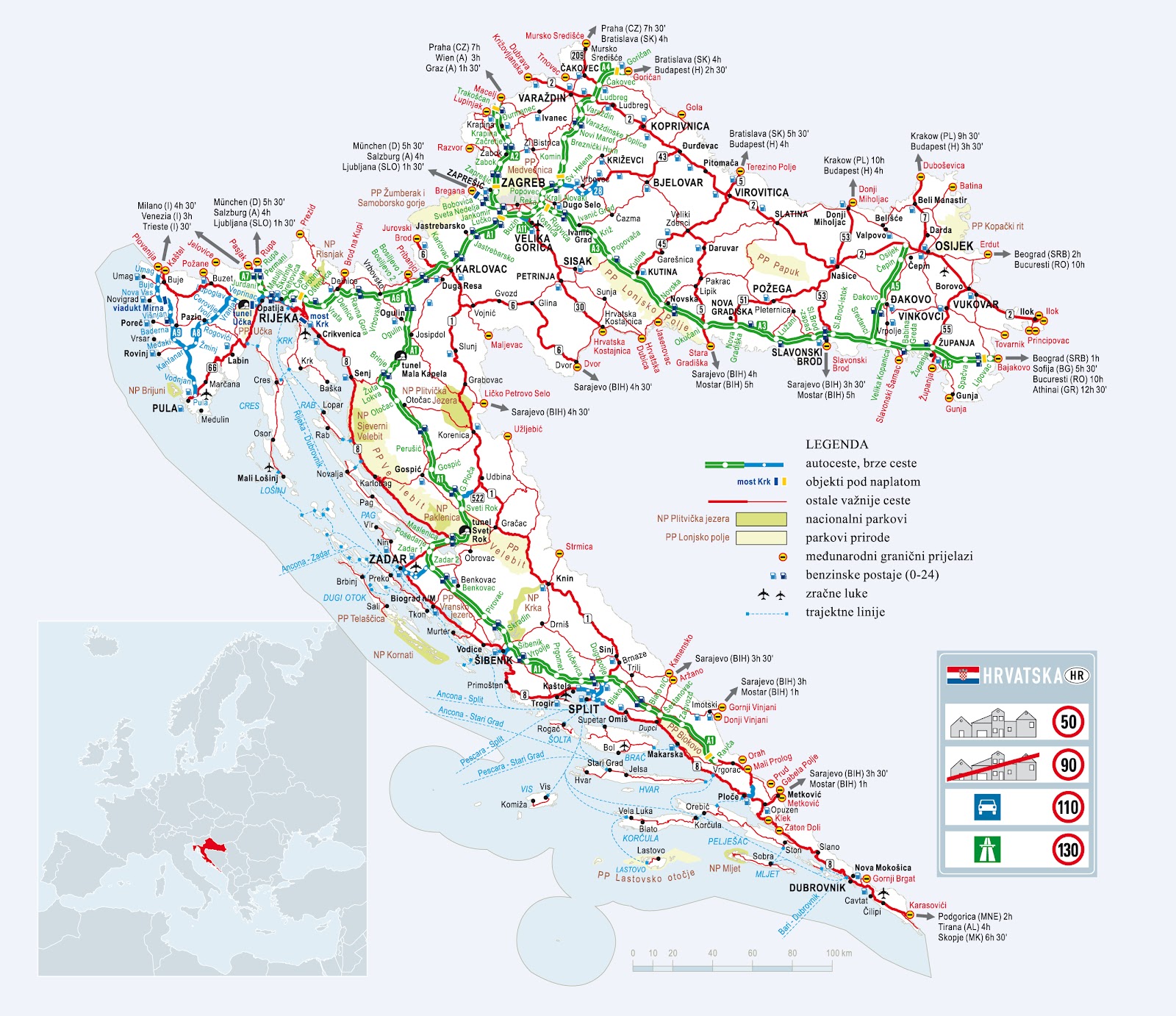
Geographic position
Croatia occupies the largest part of the eastern coast of the Adriatic Sea which, as a part of the Mediterranean Sea, penetrates deepest into European soil.
Croatia’s shoreline and numerous islands enjoy the majority of the Adriatic coastline. The narrow Dinara Mountain Range separates the country’s Mediterranean region from its central European continental part, which spans from the easterly edges of the Alps in the North-West to the shores of the Danube in the East, encompassing the southern part of the fertile Pannonian lowlands.
Surface area
Surface area
The mainland covers an area of 56 594 km2 and coastal waters cover a surface area of 31 479 km2.
Population
Population
Croatia has 4 290 612 inhabitants.
Demographics
The majority of the population are Croats, with the largest minorities being Serbs, Bosnians, Slovenes, Hungarians, Czechs, Italians and Albanians.
System of government
Croatia is a multi-party parliamentary republic.
Capital
With 792 875 inhabitants, Zagreb is the economic, transport, cultural and academic centre of the country.
Length of the coastline
6 278 km, of which 4 398 km is made up of island coastlines, solitary rocks and reefs.
Number of islands, islets, solitary rocks and reefs 1 244. The largest islands are Krk and Cres. There are 50 inhabited islands.
Highest peak
Dinara, 1 831 m above sea level.
Climate
There are three climate zones in Croatia: in the country’s continental interior the prevailing climate zone is moderately continental , while the mountain climate prevails at 1200m above the sea level. The areas along the Adriatic coast have a pleasantly mild Mediterranean climate with a large number of sunny days, summers are hot and dry and winters are mild and wet.
The average temperatures in the continental interior are: January -2 oC to 0 oC, with somewhat lower temperatures in the mountains; July temperatures reach 20 oC-22˚C, and around 13˚C in the highlands. The average temperatures in the Littoral (Adriatic Coast) are: January 5˚C - 9 oC and July 23°C - 26°C. Winter sea temperature is about 12 oC and it reaches approximately 25 oC in the summer.
Currency
The official currency in Croatia is the kuna (1 kuna = 100 lipa). Foreign currency can be exchanged in banks, exchange offices, post offices and in the majority of tourist information offices, hotels and campsites.
Credit cards (Eurocard / Mastercard, Visa, American Express and Diners) are accepted in almost all hotels, marinas, restaurants, shops and cash machines.
Power supply
Currency
The official currency in Croatia is the kuna (1 kuna = 100 lipa). Foreign currency can be exchanged in banks, exchange offices, post offices and in the majority of tourist information offices, hotels and campsites.
Credit cards (Eurocard / Mastercard, Visa, American Express and Diners) are accepted in almost all hotels, marinas, restaurants, shops and cash machines.
Power supply
220 V, frequency: 50 Hz
Tap water is safe to drink in all of Croatia.
Tap water is safe to drink in all of Croatia.

